
If you have ever stepped on a bathroom scale and felt the number lie to you, you are not alone. Weight alone cannot tell you whether you lost fat or lost muscle, whether your bones are holding strong, or whether that stubborn midsection change is really visceral fat. At the GenAge Center in Ada, MI, we use a DEXA scan to answer those questions with data instead of guesswork. This post walks through what a DEXA scan actually measures, why it matters more than the scale, and how our team in the Greater Grand Rapids area uses it to guide hormone and weight management care.
What Is a DEXA Scan, Exactly?
DEXA stands for dual-energy X-ray absorptiometry. It is a low-dose imaging scan that passes two different X-ray energy levels through your body, and because fat, lean muscle, and bone each absorb those energies differently, the scan can separate and quantify all three with a precision that a scale or a tape measure simply cannot match. You lie flat on a table for the scan, it takes only a few minutes, and the radiation exposure is a small fraction of what you would get from a standard chest X-ray.
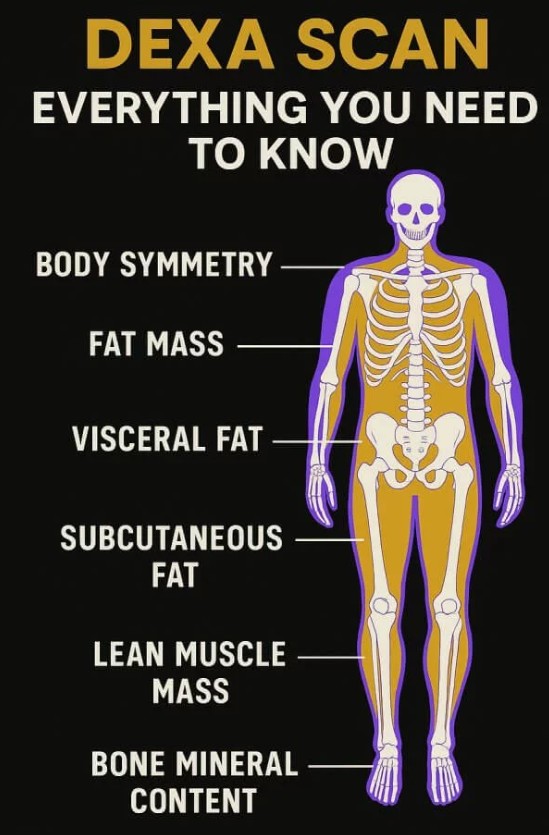
What makes DEXA the reference standard in body composition testing is not just the technology, it is what the output actually tells you. Instead of one number, you get a full breakdown: total fat mass, lean muscle mass, bone mineral density, and regional distribution, meaning how much fat sits in your arms versus your trunk versus your legs. That regional data matters because where fat is stored has real health implications, particularly when it comes to visceral fat, which is the fat that wraps around your internal organs rather than sitting just under the skin.
Visceral fat is worth understanding on its own because it behaves differently than the fat you can pinch. It is metabolically active tissue that has been linked in research to insulin resistance and cardiovascular risk, and it tends to increase during hormonal transitions like perimenopause, menopause, and andropause, the natural decline in testosterone that occurs in men as they age. A DEXA scan is one of the more direct ways to actually see how much visceral fat you are carrying, rather than estimating it from a waist measurement or a formula.
Why the Scale Doesn’t Tell the Whole Story
If your weight changed during perimenopause or after your periods stopped, you are not imagining it, and the number on the scale probably is not explaining it well either. Two people can weigh exactly the same and have completely different bodies underneath, one carrying more lean muscle and a lower fat percentage, the other carrying more fat mass and less muscle. Weight alone cannot distinguish between the two, which means it also cannot tell you whether a weight-loss effort is actually working the way you want it to.
This becomes especially important once hormone levels start shifting in midlife. Declining estrogen and testosterone are both associated with a natural loss of lean muscle mass and a redistribution of fat toward the midsection, changes that can happen even when the scale barely moves. Someone might lose ten pounds and feel encouraged, only to find that a meaningful portion of that loss was muscle rather than fat, which is not the direction anyone wants their body composition to go, particularly as bone and muscle become more protective assets with age.
If you want more than a bathroom-scale number, a DEXA body composition scan gives you a clinical read on what really changed: fat, muscle, and bone. That distinction matters whether you are:
- Tracking progress during a GLP-1 weight management program
- Monitoring the effects of hormone optimization or BHRT (bioidentical hormone replacement therapy, meaning hormones structurally identical to what your body produces) on muscle and fat
- Assessing bone density changes as you move through menopause or andropause
- Evaluating whether a training program is building lean mass or just moving the scale
- Establishing a baseline before starting any new wellness or performance plan
How GenAge Center Uses DEXA Scanning in Ada, MI
At the GenAge Center, DEXA scanning is not a stand-alone gadget test, it is one of the diagnostic tools we use to make hormone and weight management decisions based on data rather than assumption. We use a Hologic DEXA system, which is a widely used platform in clinical body composition and bone density testing, to generate the fat, muscle, and bone breakdown described above. That scan gets paired with other objective measures we offer, including Resting Metabolic Rate (RMR) testing, which measures how many calories your body burns at rest, and VO2 testing through our VO2 Master metabolic analyzer, which assesses cardiovascular fitness and how efficiently your body uses oxygen during exertion.
Dr. Hyung T. Kim, MD, leads care at GenAge Center with board certifications in integrative medicine and anti-aging and regenerative medicine, and the practice’s approach reflects that training: look at the whole physiological picture before recommending a plan. A DEXA scan on its own is informative, but its real value at our Ada practice comes from how it connects to everything else, whether that is adjusting a hormone optimization protocol, fine-tuning a GLP-1 weight management approach, or setting realistic expectations for an athlete tracking performance changes over a season.
A visit built around DEXA testing at the GenAge Center typically starts with the scan itself, which takes just a few minutes and requires no special preparation beyond avoiding heavy exercise or high calcium intake in the immediate hours before your appointment. From there, your results become part of a broader conversation, one that may also involve hormone testing, nutrition coaching, or a review of how your body composition has shifted since a previous scan. Because we offer both in-person visits in Ada and hybrid Zoom appointments, patients from Grand Rapids, Cascade, Forest Hills, and beyond can stay engaged in that conversation even between in-office testing dates.
What a DEXA Scan Can and Cannot Tell You
It is worth being direct about the limits of any single test, because no responsible provider should oversell what a scan can do. A DEXA scan gives you a precise snapshot of fat, lean mass, and bone density at one point in time, and it is genuinely useful for tracking change over months or years. What it cannot do is diagnose a hormone imbalance on its own, explain every cause behind a body composition shift, or replace a conversation with a physician about your symptoms, labs, and health history.
As curiosity continues to grow around body composition testing, it is important to separate hype from evidence. DEXA is well established in clinical and research settings as a reliable method for measuring fat, muscle, and bone, which is precisely why it is used to define osteoporosis risk in bone density assessment and why researchers rely on it in body composition studies. But a scan result is a data point, not a verdict, and its usefulness depends on having someone qualified to interpret it alongside your broader health picture, including your hormone levels, your metabolic testing, and your goals.
That is the piece we think matters most for anyone in West Michigan considering a DEXA scan for the first time. The scan itself is straightforward. What you do with the information, and who helps you interpret it, is where the real value lives.
Ready to See What’s Really Changed in Your Body?
If you are curious what a DEXA scan would reveal about your own fat, muscle, and bone composition, our team at the GenAge Center in Ada, MI is here to walk you through it. Whether you are navigating perimenopause, andropause, a weight management plan, or simply want an honest baseline before making changes, a physician-guided approach means your results are interpreted in context, not handed to you as a number and a shrug. Call us at 6167371710 or book an appointment through our online scheduling page to get started.
Frequently Asked Questions
What is a DEXA scan used for?
A DEXA scan measures body composition, meaning your fat mass, lean muscle mass, and bone mineral density, in a single low-dose imaging session. It is commonly used to track changes during weight management, hormone optimization, and bone health monitoring, and to establish a baseline before starting a new health or fitness plan.
Where can I get a DEXA scan near Ada, MI?
GenAge Center in Ada, MI offers DEXA body composition testing using a Hologic system, one of the widely used platforms in clinical body composition and bone density scanning. The practice serves patients throughout the Greater Grand Rapids area, including Cascade, Forest Hills, and Grand Rapids, with in-person appointments available at the Ada location.
Does a DEXA scan hurt or expose you to a lot of radiation?
A DEXA scan is painless and involves lying still on a table for a few minutes while the machine passes over your body. The radiation dose is very low, typically a small fraction of what a standard chest X-ray delivers.
How is a DEXA scan different from a regular bathroom scale?
A bathroom scale only gives you total body weight, with no way to distinguish fat from muscle or bone. A DEXA scan separates those components and shows regional distribution, including visceral fat around the organs, which gives a much more complete picture of what is actually changing in your body.
How often should I get a DEXA scan to track progress?
The right interval depends on your goals, whether that is monitoring a weight management program, hormone optimization, or bone density over time, and is best determined with a physician who can interpret changes in context. Scanning too frequently rarely adds meaningful information, since body composition typically shifts gradually over months rather than weeks.