
Perimenopause Weight Gain: What’s Actually Happening Hormonally
If your weight has crept up over the last few years and nothing about your eating or exercise habits has actually changed, you are not imagining it. Perimenopause weight gain is one of the most common and most misunderstood shifts a woman’s body goes through, and it is not simply a matter of willpower or discipline. At the GenAge Center in Ada, MI, we talk with women every week who are frustrated by a scale that keeps climbing despite doing everything “right.” The truth is that your hormones are changing the rules, and understanding that shift is the first step toward working with your body instead of against it.
Perimenopause is the transitional period, often lasting several years, leading up to menopause (defined as 12 consecutive months without a period). During this time, estrogen and progesterone don’t decline in a smooth, predictable line. Instead, they fluctuate unevenly, sometimes spiking, sometimes dropping sharply, which can wreak havoc on appetite regulation, sleep, mood, and where your body chooses to store fat.
Estrogen plays a direct role in how your body manages insulin sensitivity and fat distribution. As estrogen becomes less stable, many women notice a shift from a “pear” pattern of fat storage (hips and thighs) to an “apple” pattern, with more fat accumulating around the abdomen. This isn’t cosmetic. That abdominal fat is often visceral fat, the metabolically active fat that surrounds your internal organs rather than sitting just under the skin. Visceral fat is associated with increased inflammation and greater metabolic risk, which is part of why perimenopause weight gain deserves more attention than a “just eat less” response.
At the same time, declining progesterone can disrupt sleep quality, and poor sleep independently drives up cravings and cortisol, the stress hormone that also promotes abdominal fat storage. Add in the natural, age-related decline in muscle mass that begins well before perimenopause, and you have a perfect storm: less muscle to burn calories at rest, a hormonal environment that favors fat storage over fat burning, and disrupted sleep that makes everything harder to manage. None of this means your body is failing you. It means your body is responding predictably to a real physiological shift.
Why the Scale Doesn’t Tell the Whole Story
Here’s where a lot of well-meaning advice falls short: a bathroom scale cannot tell you what kind of weight you’ve gained or lost. Two women who are the exact same weight can have completely different body compositions, one with significantly more muscle and less visceral fat, the other the reverse. That difference matters enormously for long-term health, mobility, and metabolic function, yet the scale treats them identically.
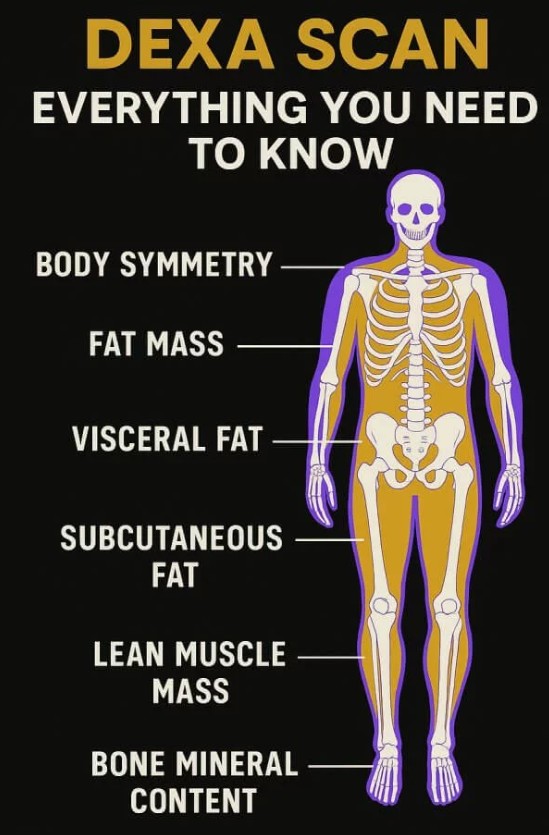
This is why we rely on a DEXA scan (dual-energy X-ray absorptiometry) rather than weight alone. A DEXA scan is a low-dose imaging test that gives a precise breakdown of fat mass, lean muscle mass, and bone density throughout your body, including a specific readout on visceral fat. At the GenAge Center, we use a Hologic DEXA system to give patients a clinical, objective look at what has actually changed during perimenopause, rather than guessing based on a single number.
Pairing that with metabolic testing tells an even fuller story. Resting Metabolic Rate (RMR) testing measures how many calories your body burns at rest, which often shifts as muscle mass and hormones change. VO2 testing, performed with our VO2 Master metabolic analyzer, measures how efficiently your body uses oxygen during exercise, which reflects cardiovascular fitness and metabolic conditioning. Together, these tools replace guesswork with data you can actually track over time.
These insights can also help guide the GenAge Center’s Mature Eating approach, which uses individualized nutrition strategies to support metabolic health, maintain lean muscle, and establish sustainable eating habits based on your body’s needs.
How GenAge Center Approaches Perimenopause Weight Gain
Dr. Hyung T. Kim, MD, DiplABIM, DiplABAARM, DiplABLM, leads a physician-directed approach at the GenAge Center that treats perimenopause weight gain as a hormonal and metabolic issue, not a discipline problem. That distinction shapes everything about how a visit unfolds. Rather than starting with a generic diet plan, we start with data: hormone testing to understand where estrogen, progesterone, testosterone, and related markers actually stand, alongside body composition and metabolic testing to see how those hormonal shifts are showing up in your muscle, fat, and resting metabolism.
Rather than relying on restrictive diets, GenAge’s Mature Eating philosophy emphasizes personalized, practical nutrition strategies, including appropriate protein intake, fiber, hydration, and meal planning to support muscle preservation and long-term metabolic health.
From there, options are personalized rather than one-size-fits-all. For some women, that means exploring bioidentical hormone replacement therapy (BHRT), which uses hormones structurally identical to those your body produces naturally, to help stabilize the fluctuations driving symptoms like abdominal fat gain, sleep disruption, and low energy. For others, especially where weight gain has outpaced what hormone optimization alone can address, GLP-1 medications may be part of a clinical weight management plan, always with physician oversight and realistic expectations about what these tools can and cannot do. Peptide therapy and nutrition coaching may also play a role depending on individual goals and lab findings.
Mature Eating coaching can complement these treatment options by helping patients develop realistic eating habits that support their individual metabolic needs, particularly when protecting muscle mass during weight loss is a priority.
What we won’t do is promise a guaranteed number on the scale or a specific timeline. What we can offer is a structured, physician-directed process: testing, a clear conversation about findings, a plan built around your actual physiology, and objective ways to measure whether that plan is working. For women in Ada, Cascade, and the greater Grand Rapids area, that means having a local option that treats perimenopause as a medical transition worth investigating properly, not a personal failing to push through alone.
Practical Steps You Can Take Right Now
While hormone testing and clinical evaluation give you the clearest picture, there are foundational habits that support your body through this transition regardless of where you land on treatment.
Prioritize protein intake and resistance training to protect the muscle mass that naturally declines with age and hormonal change. GenAge’s Mature Eating approach can help personalize protein goals and translate them into practical, sustainable meals.
Treat sleep as a metabolic priority, not a luxury, since poor sleep directly worsens cortisol-driven abdominal fat storage.
Track body composition rather than weight alone, so you can see whether fat, muscle, or both are shifting over time.
Limit reliance on restrictive dieting, which can worsen muscle loss and further slow metabolism during a period when your body is already working against you. Instead, focus on Mature Eating principles that emphasize balanced nutrition, adequate protein, fiber, hydration, and realistic meal planning.
Talk with a physician before starting any hormone or weight-management therapy, so your plan reflects your actual labs and history rather than general assumptions.
These steps won’t reverse the hormonal shifts of perimenopause, but they can meaningfully change how your body responds to them, and they give any future clinical treatment a stronger foundation to build on.
Ready to Understand What’s Really Changing?
If perimenopause weight gain has left you frustrated and unsure what to trust, you don’t have to figure it out with guesswork. GenAge Center in Ada, MI offers physician-directed hormone testing, DEXA body composition scanning, and metabolic testing so you can see, in clear clinical terms, what’s actually happening in your body. Personalized Mature Eating guidance can also be incorporated to help you build sustainable nutrition habits that support your metabolic and body composition goals. We offer both in-person and hybrid Zoom appointments for patients throughout West Michigan and beyond. To schedule a consultation, call us at 616-737-1710 or book directly through our online scheduling system.
Frequently Asked Questions
Why do I gain weight around my stomach during perimenopause even though I haven’t changed my diet?
Fluctuating estrogen levels during perimenopause shift how your body distributes fat, often moving storage toward the abdomen and increasing visceral fat around internal organs. Combined with declining muscle mass and disrupted sleep, this can cause abdominal weight gain even without changes to diet or exercise habits.
A personalized Mature Eating plan may help address changing nutritional and metabolic needs by focusing on appropriate protein intake, balanced meals, and sustainable habits.
Is perimenopause weight gain permanent?
Perimenopause weight gain is not necessarily permanent, but it does typically require a different approach than weight management strategies used earlier in life. Addressing hormone balance, muscle preservation, and metabolic rate through physician-guided testing can help identify what’s driving the change and inform an appropriate plan.
Combining these insights with Mature Eating strategies can help support long-term weight management without relying on overly restrictive diets.
What is a DEXA scan and how does it help with perimenopause weight gain?
A DEXA scan is an imaging test that measures body fat, lean muscle mass, and bone density with clinical precision, including visceral fat around the organs. It gives a far more useful picture than the scale alone, showing whether weight changes involve fat, muscle, or both.
Where can I get hormone testing for perimenopause weight gain near Ada, MI?
GenAge Center in Ada, MI offers hormone testing along with DEXA body composition scanning and metabolic testing for women navigating perimenopause. Appointments are available in-person or via hybrid Zoom for patients throughout the Grand Rapids area.
Does bioidentical hormone replacement therapy help with perimenopause weight gain?
Bioidentical hormone replacement therapy (BHRT) uses hormones structurally identical to those the body produces and may help stabilize some of the hormonal fluctuations linked to abdominal fat gain, sleep disruption, and low energy. Candidacy depends on individual hormone testing and health history, which is why a physician evaluation is an important first step.